On the evening of Easter, what was meant to be a quiet family gathering turned into one of the most emotional and defining moments ever witnessed inside the Trump family.
The setting was intimate. Held at a private residence, the event was designed to be simple—just close family, a few trusted friends, and a shared dinner to mark a day traditionally centered on reflection, renewal, and togetherness. There were no cameras, no press, and no political undertones. For Donald Trump and Melania Trump, it was supposed to be a rare pause from public life.
The room was softly lit, conversations were low, and the atmosphere carried a calm, almost sacred stillness. Guests spoke quietly, exchanging polite smiles and familiar stories. Nothing about the evening suggested that it would become anything more than a peaceful holiday gathering.
That changed when Barron Trump stood up.
There was no announcement. No signal. No one introduced him. At first, it seemed like a simple movement—perhaps he was stepping away or preparing to say something brief. But as he walked toward the center of the room, the conversations began to fade. One by one, people turned their attention toward him.
Donald Trump, seated nearby, looked up with mild curiosity. Melania, sitting beside him, followed Barron with her eyes, her expression calm but attentive.
Barron stopped, took a breath, and looked directly at his parents.

For a moment, he said nothing.
The silence stretched just long enough to shift the mood of the room.
Then he began to speak.
His voice, though steady at first, carried a weight that was immediately noticeable.
“I know I don’t say things like this often,” he started. “But tonight… I think I should.”
The simplicity of the opening line caught everyone off guard. Barron had always been known for his reserved nature, rarely stepping into moments of public or even semi-public expression. What he was doing now felt unfamiliar—and important.
Donald Trump leaned back slightly, his posture still composed, but his attention fully fixed on his son. Melania’s expression softened almost instantly.
Barron continued.
“I’ve watched everything,” he said. “Not just what people see. Everything.”
There was no hesitation in his voice now, only honesty.
“I’ve seen the pressure. The noise. The way things change so quickly… and how you both handled it.”
As he spoke, the room remained completely silent. No one shifted. No one interrupted.
Donald Trump’s expression began to change. The firmness that often defined his presence gave way to something more reflective. His eyes narrowed slightly—not in focus, but in restraint.
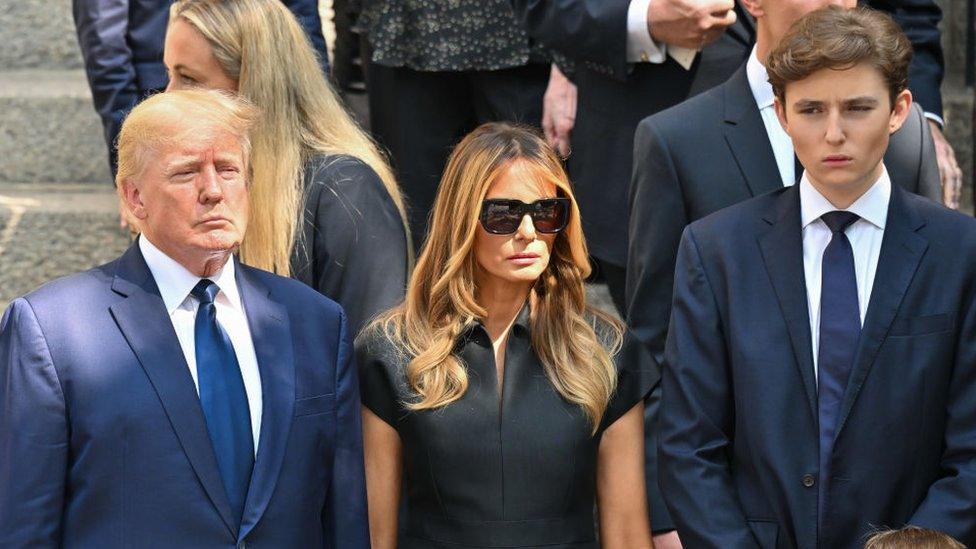
Barron turned slightly toward his father.
“Dad… people say a lot of things. Good and bad. But that’s not what I see.”
Trump lowered his gaze for a brief second, then looked back up. His hands, resting on his lap, slowly came together, fingers interlacing—a subtle sign of tension or control.
“I see someone who never stopped,” Barron said. “No matter what.”
The words landed heavily.
Melania, seated beside Donald, raised her hand toward her face, pressing her fingers lightly against her lips. Her eyes remained fixed on her son, already beginning to glisten.
Barron then looked at his mother.
“And Mom… I saw you too. Always there. Even when you didn’t say anything. You never left.”
Melania’s composure faltered. She blinked slowly, trying to steady herself, but the emotion was visible.
Barron paused briefly, taking a breath.
“I don’t think I’ve ever said thank you properly,” he admitted.
The honesty of the statement shifted the energy in the room once more.
“So… thank you,” he said. “For everything you did. For everything you went through. For being there—even when it wasn’t easy.”
At that moment, Donald Trump exhaled slowly, a breath that seemed to carry more than just air. He turned his head slightly away, pressing his lips together as if trying to maintain composure.
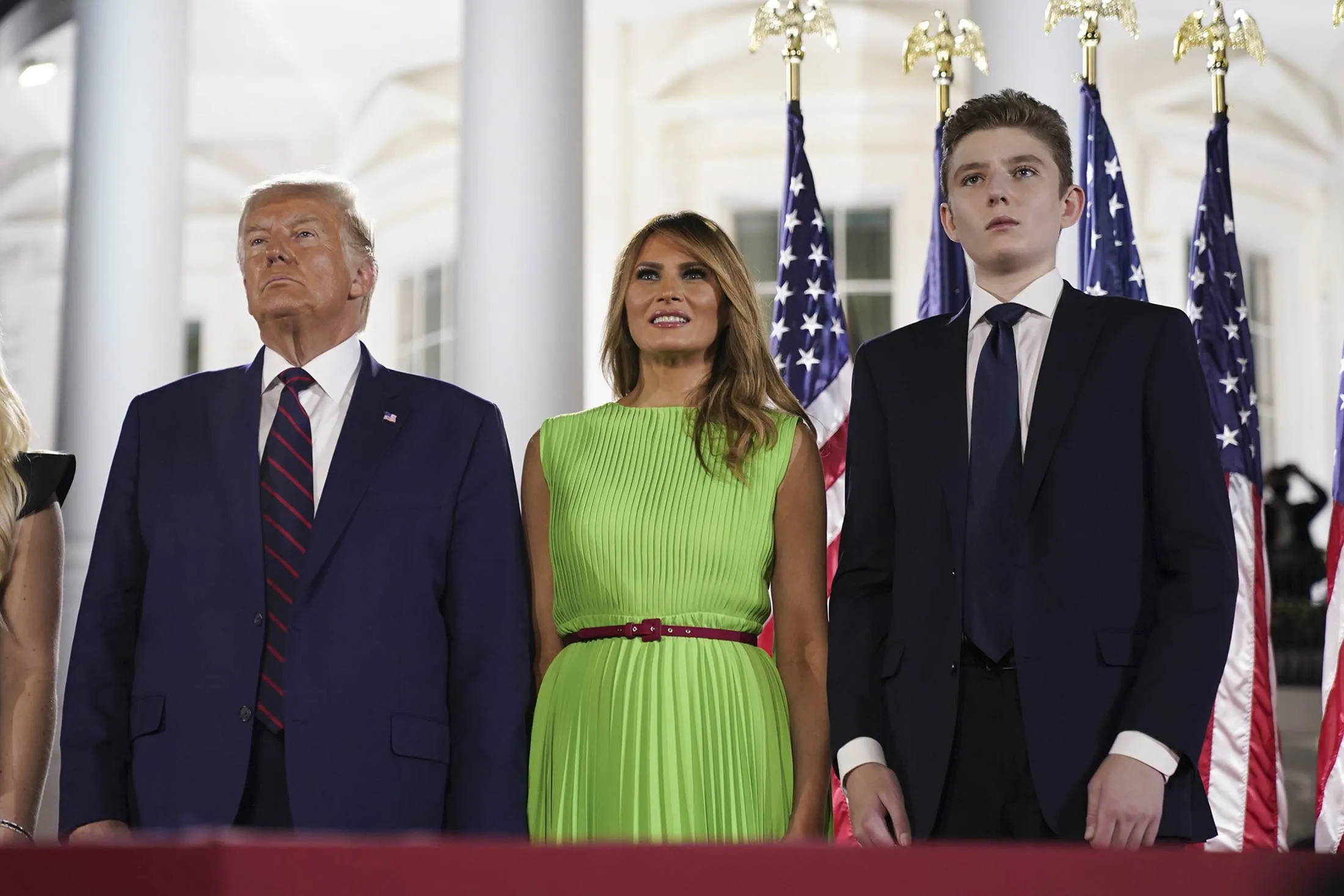
But it was clear—he was affected.
When he looked back at Barron, his eyes were noticeably glassy.
Melania, no longer holding back, wiped a tear from the corner of her eye. She reached for Donald’s hand, and he responded immediately, holding hers firmly.
Barron’s voice softened for his final words.
“I don’t say this a lot… but I’m proud of you. Both of you.”
The room remained completely still.
No applause. No movement.
Just silence.
A silence filled with understanding.
Barron stepped back slightly, signaling that he had finished. He didn’t look around the room. He didn’t wait for a reaction. He simply looked at his parents.
Donald Trump stood up.
Slowly.
Deliberately.
He didn’t speak right away. Instead, he walked toward his son and placed a hand on his shoulder. For a brief moment, the two stood facing each other—no words, just acknowledgment.
Then Trump pulled him into a brief embrace.
It was not a long or dramatic gesture, but it was enough to say everything that hadn’t been spoken.
Melania joined them moments later, placing her hand gently on Barron’s back, her expression still emotional but filled with quiet pride.
The room, still silent, witnessed something deeply personal—something rarely seen from a family so often defined by public narratives.
Eventually, the evening resumed. Conversations returned, though softer than before. The tone had changed. What had started as a simple Easter gathering had become something far more meaningful.
In the days that followed, those who were present would describe the moment in similar ways.
“It wasn’t planned,” one guest said. “And that’s why it mattered.”
Another added, “It wasn’t about who they are in public. It was about who they are to each other.”
For Donald and Melania Trump, the evening marked something rare—not a political milestone, not a public statement, but a personal moment of recognition from someone who had watched it all from the closest place possible.
Their son.
And on a night defined by renewal, reflection, and meaning, it became something else entirely:
A moment of truth.
One that no one in that room would forget.


0 commentaires:
Enregistrer un commentaire