
It was meant to be a quiet, almost routine interview — the kind that marks a milestone without turning it into spectacle. The occasion was simple: a reflection on Barron Trump as he turned 20. No grand stage, no political undertones, just a conversation.
But what unfolded during that interview with Melania Trump would resonate far beyond the room.
Seated across from the interviewer, Melania carried her usual composure — measured, elegant, and deliberate in every word. She didn’t speak like a public figure addressing an audience. Instead, she spoke like a mother reflecting on time that had passed faster than expected.
“He’s grown into his own person,” she began, her voice calm, almost reflective. “But in many ways… he reminds me of his father.”
The comparison was not surprising. For years, observers had pointed out the physical resemblance between Barron and Donald Trump — the height, the posture, even the facial expressions that occasionally echoed a younger version of the former president.

Melania acknowledged it without hesitation.
“From the outside, yes — the resemblance is clear,” she said. “The way he carries himself, the way he observes before he speaks… there are similarities.”
But what she said next shifted the tone of the conversation.
“People often assume he’s exactly the same,” she continued, pausing briefly as if choosing her words with care. “But that’s not entirely true.”
The interviewer leaned in slightly, sensing something more.
Melania didn’t dramatize the moment. She didn’t lower her voice or signal that she was about to reveal something unexpected. Instead, she spoke plainly — and in doing so, made the distinction even more striking.
“Barron is much more reserved,” she said. “He takes his time. He listens more than he speaks. He doesn’t react quickly — he thinks first.”
It was a subtle contrast, but a meaningful one.
Without naming it directly as a difference, she had drawn a clear line between father and son.
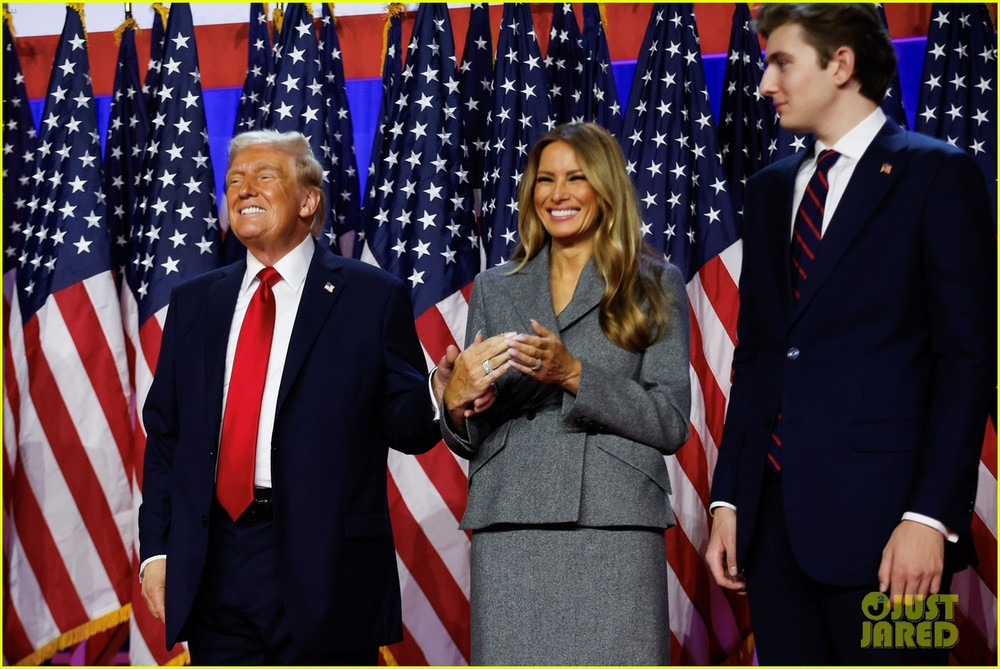
Where Donald Trump had built a public persona known for decisiveness, bold statements, and at times, impulsive reactions, Barron, according to his mother, had developed in the opposite direction.
“He’s calm,” Melania added. “Very calm. Even in situations where others might respond immediately, he steps back.”
The room was quiet — not because the statement was controversial, but because it felt personal. Honest in a way that wasn’t often seen in public conversations about the Trump family.
The interviewer nodded, allowing the moment to breathe.
“Do you think that comes from you?” they asked.
Melania gave a small, knowing smile.
“I think every child carries something from both parents,” she said. “But yes… that part feels familiar.”
It was the closest she came to acknowledging her influence directly.
She went on to describe Barron’s approach to life — not in dramatic anecdotes, but in small, telling details.
“He’s very thoughtful about the people around him,” she explained. “He doesn’t rush into friendships, but when he connects with someone, it’s genuine. He values privacy. He values space.”
Growing up in one of the most public families in the world, Barron’s inclination toward privacy had long been noted, though rarely discussed in depth. Unlike many public figures’ children, he had largely stayed out of the spotlight, appearing only when necessary and otherwise maintaining a low profile.
Melania confirmed that this was not by accident.
“We’ve always tried to give him a sense of normalcy,” she said. “As much as possible.”
The interviewer asked about challenges — about growing up under constant public attention, about expectations, about pressure.
Melania didn’t dismiss the question.

“It’s not always easy,” she admitted. “But he’s learned how to manage it in his own way. By not reacting to everything. By choosing what matters.”
Again, the contrast was clear — not stated, but understood.
Where public life often rewards quick responses and strong reactions, Barron had chosen a different approach: distance, reflection, and restraint.
As the conversation continued, Melania spoke about his interests, his studies, and his plans — though she kept specifics limited. What she emphasized instead was character.
“At this stage, it’s not about what he does,” she said. “It’s about who he becomes.”
There was no grand conclusion, no dramatic reveal. The interview didn’t end with a headline-ready statement or a defining quote designed to go viral.
And yet, when it aired, something about it resonated.
Clips began circulating online — not because of controversy, but because of clarity. Viewers picked up on the contrast Melania had described, discussing it in comment sections and forums, not as speculation, but as interpretation.
Many noted the same thing: the image of Barron that emerged from the interview was not a replication of his father, but a variation — shaped by the same environment, yet guided by a different temperament.
The idea of similarity had been expected.
The difference had not.
And perhaps that was what made the conversation linger.
In a world where public figures are often defined by comparison, Melania had offered something more nuanced: a portrait of a young man influenced by both parents, yet distinct in his own way.
By the end of the interview, nothing felt sensational.
But something felt clear.
Barron Trump, at 20, was not simply following in familiar footsteps.
He was choosing how to walk his own path — quietly, deliberately, and on his own terms.


0 commentaires:
Enregistrer un commentaire