
In a city known for its constant motion and relentless noise, it is rare for a room full of people to fall completely silent. Yet that is exactly what happened during a private evening event in New York—an occasion originally intended to celebrate legacy, family, and the next generation stepping into public view.
At the center of that unexpected moment was Barron Trump—a figure who, despite growing up under intense public attention, has remained largely reserved and out of the spotlight. Few expected him to take the lead that night. Even fewer anticipated what he would choose to say.
A Night Meant for Transition
The event itself had been carefully organized. Hosted in an upscale Manhattan venue, it brought together business associates, longtime acquaintances, and a select group of media figures. The theme revolved around continuity—how influence, values, and responsibility are carried from one generation to the next.
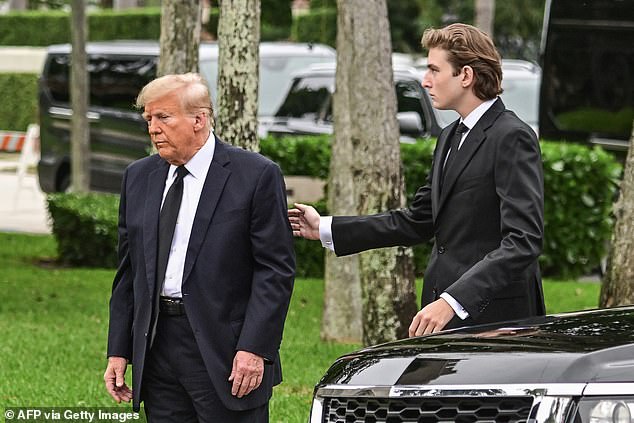
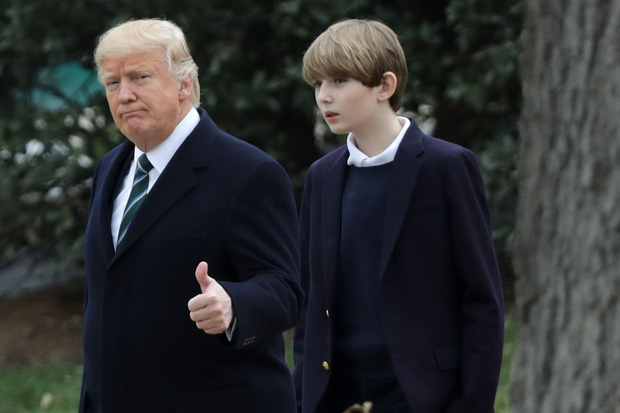
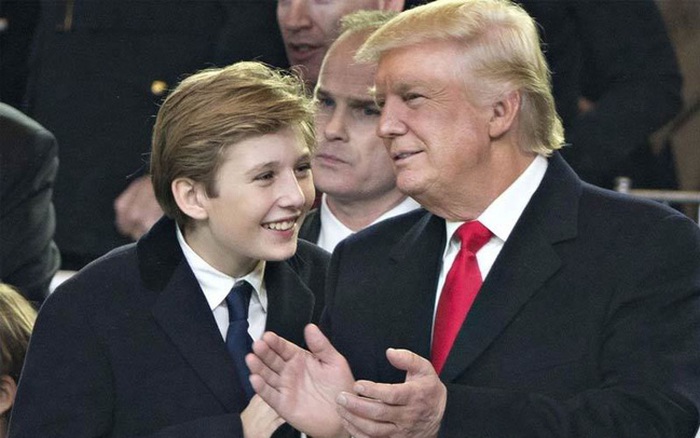
Donald Trump was present, as expected, seated among close family members, including Melania Trump. While Donald Trump has long been the central figure in public discussions, the evening subtly shifted attention toward Barron, signaling a moment of quiet transition.
For much of the night, Barron remained in the background—observing, listening, and engaging only when approached. Those familiar with him described his demeanor as composed, thoughtful, and measured.
Nothing about his behavior suggested that he would soon become the focal point of the evening.
The Unexpected Pause
As the program moved toward its conclusion, the host invited Barron to say a few words. It was meant to be a brief acknowledgment—a gesture rather than a defining moment.
Barron stood.
At first, he appeared calm but restrained, as if carefully considering what to say. The room quieted out of courtesy, not expectation.
Then, something shifted.
Instead of beginning immediately, Barron paused. His gaze moved across the room—past the audience, past the stage lights—until it settled on his father.
That pause, subtle as it was, changed the atmosphere.
A Gesture No One Anticipated
Without announcing his intention, Barron stepped away from the podium and walked toward the front row. There, a seat had been reserved but left unoccupied—a symbolic placement, though few had paid attention to it earlier in the evening.
From a nearby table, Barron picked up a simple name card bearing his father’s name.
He placed it carefully on the seat.
Then he turned back toward the audience.
“You never asked for recognition,” he said, his voice steady but quieter than expected. “You never needed it.”
The words were not dramatic, but they carried weight.
“For years, people have seen the public side—the speeches, the decisions, the headlines,” he continued. “But they haven’t seen the other side. The discipline. The persistence. The responsibility that doesn’t stop when the cameras turn off.”
A Personal Perspective
Barron’s remarks did not follow a prepared script. There were no rhetorical flourishes, no attempts to draw applause.
Instead, he spoke from a personal perspective—one shaped not by observation from afar, but by lived experience.
He described growing up in an environment where expectations were high and visibility was constant. He acknowledged the challenges that came with it, but also the lessons he had taken from it.
“There were moments when it would have been easier to step back,” he said. “But you didn’t.”
He did not elaborate on specific events, nor did he need to. The audience understood the reference.
A Rare Public Recognition
For Donald Trump, a figure accustomed to commanding attention, the moment represented something different: being acknowledged not for public achievements, but for personal influence.
Throughout Barron’s remarks, Trump remained seated, his expression controlled but attentive. Observers noted a rare stillness in his demeanor—an absence of the usual reactions that often accompany public appearances.
Melania Trump, seated nearby, watched quietly.
Her reaction was subtle but noticeable—a slight shift in posture, a steady focus on her son, and a composed presence that reflected both attentiveness and restraint.
The Room Responds
As Barron concluded his remarks, he did not immediately return to the podium. Instead, he remained where he stood, allowing a brief silence to settle over the room.
That silence lasted only a few seconds, but it felt longer.
Then, gradually, the audience began to respond.
The applause was not immediate or explosive. It built slowly—measured, respectful, and sustained.
Those present later described the reaction as genuine, not performative.
Beyond the Public Image
What made the moment significant was not just the content of Barron’s words, but the context in which they were delivered.
For years, public perception of Donald Trump has been shaped largely by his external actions—his business ventures, political career, and media presence. Rarely has the focus shifted to how he is viewed within his own family.
Barron’s remarks provided a glimpse into that perspective.
It was not a redefinition, but an addition—a layer that had not often been visible to the public.
A Lasting Impression
As the evening concluded, conversations throughout the venue reflected a shared sentiment: something unexpected had taken place.
It was not a political statement. It was not a strategic move.
It was a personal moment—simple in its structure, but significant in its impact.
Barron Trump, who had spent much of his life outside the spotlight, had stepped forward—not to claim attention, but to redirect it.
In doing so, he created a moment that resonated far beyond the room.
The Meaning of the Moment
In a world where recognition is often pursued, the idea of giving it—quietly, deliberately—can carry a different kind of power.
Barron’s gesture, placing his father’s name on an empty seat, was symbolic but clear.
It represented acknowledgment.
It represented perspective.
And perhaps most importantly, it represented a connection that exists beyond public roles and public narratives.
Conclusion
By the end of the night, the event had fulfilled its original purpose—highlighting legacy and continuity.
But it had also done something more.
It had revealed a moment of sincerity in a setting often defined by formality.
And for those who witnessed it, that moment stood out—not because it was loud or dramatic, but because it was real.
In the end, it wasn’t the speeches or the setting that defined the evening.
It was a son, standing in front of a room full of people, choosing to recognize his father—not as the world sees him, but as he knows him.


0 commentaires:
Enregistrer un commentaire