Top Ad 728x90

vendredi 10 juillet 2026

Hillary Clinton Ticks Off More Americans With Voter ID Remark Like Only She Can

by


Hillary Clinton's Voter ID Remarks Spark Fresh Debate Over Election Access and Security

Introduction


Election laws have long been among the most debated topics in American politics. Few issues generate as much disagreement as voter identification requirements, with supporters arguing they protect election integrity and opponents warning they can make voting more difficult for some eligible citizens.


Recently, comments by former Secretary of State and 2016 Democratic presidential nominee Hillary Clinton reignited that debate, prompting strong reactions across social media, political commentators, and everyday voters. Supporters defended her position as highlighting genuine concerns about voting access, while critics argued her remarks underestimated Americans' ability to obtain identification and cast ballots.


The conversation once again illustrates how election security remains one of the country's most divisive political topics.


What Hillary Clinton Said


During a public discussion about voting rights and election laws, Hillary Clinton criticized stricter voter identification requirements implemented in several states.


Her argument centered on concerns that certain groups—including elderly citizens, students, low-income Americans, rural residents, and minorities—may face greater challenges obtaining acceptable forms of identification.


She suggested that lawmakers should focus on making voting easier rather than creating additional requirements that could discourage participation.


Although Clinton has expressed similar views for years, these latest remarks quickly spread online, generating renewed attention.


Why the Comments Went Viral


Political debates today rarely stay confined to speeches or television interviews.


Within hours, clips of Clinton's remarks circulated across social media platforms.


Commentators from across the political spectrum weighed in.


Some praised her for defending voting rights.


Others accused her of misrepresenting how voter ID laws actually work.


The discussion expanded beyond Clinton herself, becoming another chapter in America's ongoing debate over election administration.


Understanding Voter ID Laws


Voter identification laws require individuals to verify their identity before receiving a ballot.


Different states have different rules.


Some require government-issued photo identification.


Others accept non-photo documents such as utility bills, bank statements, or student identification cards.


Several states provide free identification specifically for voting purposes.


Meanwhile, a number of states require no identification at all for most voters.


Because election administration largely occurs at the state level, there is no single national voter ID standard.


Why Supporters Favor Voter ID


Advocates argue voter ID laws provide several benefits.


Protecting Election Integrity


Supporters believe verifying identity helps ensure each eligible voter casts only one ballot.


They argue identification requirements increase confidence in election results.


Building Public Trust


Polling has consistently shown many Americans support some form of voter identification requirement.


Proponents say public confidence matters just as much as preventing actual fraud.


Similar Requirements Exist Elsewhere


Supporters often note that identification is commonly required for activities such as:


Boarding airplanes

Opening bank accounts

Purchasing certain products

Entering government buildings

Picking up prescriptions


They argue voting, one of democracy's most important activities, should include identity verification as well.


Why Opponents Raise Concerns


Critics acknowledge election security is important but argue some voter ID policies may unintentionally affect eligible voters.


Common concerns include:


Access to Identification


Not everyone possesses a current government-issued photo ID.


Replacing lost documents can sometimes require time, transportation, or fees.


Rural Communities


Residents living far from licensing offices may have difficulty obtaining new identification.


Elderly Citizens


Older Americans who no longer drive may allow licenses to expire.


Obtaining replacements may present challenges.


Students


Some states accept student IDs while others do not.


This inconsistency has become part of the broader debate.


The Data Behind Election Fraud


One of the central questions is how common in-person voter impersonation actually is.


Numerous investigations over the years have found relatively few documented cases compared with the hundreds of millions of ballots cast in federal elections.


Supporters of voter ID respond that low numbers may reflect successful safeguards already in place.


Critics argue the rarity of documented cases suggests stricter identification requirements address an uncommon problem.


The interpretation of available evidence remains politically contested.


Public Opinion


Opinion surveys have generally shown broad support for voter identification requirements across political affiliations.


However, polling also indicates Americans support making identification readily available at little or no cost.


Many respondents simultaneously support:


Secure elections

Easy voter registration

Accessible identification

Expanded early voting


This suggests many voters view election security and voter access as complementary rather than mutually exclusive goals.


How States Differ


Election rules vary considerably.


Some states require strict photo identification.


Others allow voters without ID to sign affidavits.


Several accept a wide range of identification documents.


Mail voting procedures also differ significantly.


Because states administer elections independently, debates over voter ID often reflect local political priorities rather than national standards.


Why Election Laws Matter


Voting rules influence public confidence in democracy.


Even small procedural changes can become politically significant because elections determine leadership at every level of government.


As a result, discussions about identification requirements frequently extend beyond technical policy into broader questions about fairness, accessibility, and trust.


Political Reactions


Republican leaders largely criticized Clinton's remarks.


Many argued modern identification requirements are reasonable and widely accepted.


Several pointed to opinion polls indicating strong public support for voter ID.


Democratic officials, meanwhile, defended Clinton's broader point that election laws should avoid creating unnecessary barriers for eligible voters.


They emphasized expanding access while maintaining election security.


Social Media Response


Online reactions reflected the nation's political divide.


Supportive users praised Clinton for speaking about voting rights.


Critics argued her comments overlooked how common identification already is in everyday life.


Hashtags related to voter ID quickly trended as political influencers, journalists, and advocacy groups joined the discussion.


The debate demonstrated how quickly election-related topics can dominate online conversations.


The Broader Context


The debate surrounding voter identification is not new.


For decades, lawmakers, courts, advocacy organizations, and election officials have debated how best to balance two important goals:


Protecting election integrity.

Ensuring every eligible citizen can vote without unnecessary obstacles.


Court decisions have generally recognized that states have legitimate interests in securing elections while also requiring that voting laws comply with constitutional protections and federal voting rights laws.


Looking Ahead


As future elections approach, voter ID policies will likely remain central issues in legislative sessions and political campaigns.


Some states continue expanding identification requirements.


Others have moved toward broader voting access through early voting, mail ballots, and automatic voter registration.


The national conversation is unlikely to end soon, particularly as election administration continues evolving.


Conclusion


Hillary Clinton's recent comments once again brought national attention to one of America's most persistent political debates. Whether one agrees with her perspective or not, the discussion highlights the challenge of balancing election security with broad voter participation.


Supporters of voter ID laws argue that verifying identity strengthens public confidence and helps protect elections. Opponents contend that lawmakers should ensure identification requirements do not unintentionally discourage or burden eligible voters.


My Daughter’s Best Friend Sewed Her a Prom Dress After Every Shop Turned Her Away — What He Hid in the Blue Flowers Left the Whole Room Silent

by


At the fourth boutique, the saleswoman looked my daughter up and down and said, “Sweetheart, that dress was not made for your body.”

My daughter didn’t cry.

She simply turned around, walked out of the shop, and got into my car like something inside her had finally gone quiet.

I stood there holding my purse, staring at the gown in the window — ivory silk, soft sleeves, and tiny blue flowers sewn along the skirt — and for the first time since my son passed away, I felt like I had failed the child I still had left.

My name is Marcy Whitaker, and for almost a year, my house had sounded like a place waiting for someone to come home.

But no one did.

My son, Owen, was twenty-one when we lost him. One rainy Tuesday evening, another driver lost control on Route 14. By the time the police officer stood on my porch, hat in his hands, I already knew something was wrong.

Owen had always texted before dinner.

He never missed taco night.

After the funeral, my daughter, Brenna, stopped being seventeen. She stopped dancing in the kitchen. She stopped singing badly in the shower. She stopped leaving her room unless she had to.

Before everything changed, Brenna had been loud in the sweetest way. She laughed with her whole body. She wore bright sweaters even in summer. She once made an entire batch of cookies shaped like stars because Owen said the moon looked lonely.

Then he was gone.

And my daughter folded into herself like a letter no one knew how to open.

At first, I told myself grief needed time. I made soup she didn’t eat. I placed clean towels outside her door. I kept Owen’s bedroom exactly as he had left it because neither of us could bear to touch it.

Some days, Brenna cried so hard I sat on the floor outside her room and cried with her.

Other days, she said nothing at all.

The silence frightened me more.

There was only one person who seemed able to reach her.

His name was Jonah Bell.

He lived two houses down, in the blue house with the leaning mailbox. He and Brenna had been friends since middle school, back when they both had braces and wore backpacks too big for their bodies.

Jonah was quiet. Not shy exactly, just careful. He had a habit of listening like every word mattered.

After Owen passed, Jonah came by almost every afternoon. Sometimes he brought homework. Sometimes he brought a milkshake and left it on Brenna’s desk. Sometimes he simply sat on the porch beside her while she stared at the street.

He never pushed.

Once, I found them sitting on the front steps at dusk. Brenna was wrapped in Owen’s old college hoodie, her head resting against the railing. Jonah had a sketchbook open on his knees, but his pencil wasn’t moving.

“She ate some crackers today,” he said when I stepped outside.

I had to hold the doorframe to steady myself.

“Thank you,” I whispered.

Jonah looked confused. “For what?”

“For staying.”

He shrugged like staying was easy.

To him, maybe it was.

Spring came slowly that year. The trees bloomed, neighbors started mowing their lawns again, and prom signs appeared in the windows of every little shop downtown.

I hated those signs at first.

Prom felt cruel. Dresses and flowers and photographs and music felt like they belonged to another life.

Then one morning, while I was packing away laundry, I found an old picture tucked inside Brenna’s drawer.

It was from two summers before. Owen had one arm around Brenna’s shoulders and the other holding a ridiculous plastic crown from a birthday party. Brenna was laughing so hard her eyes were closed.

On the back, in Owen’s messy handwriting, he had written:

if nobody takes bren to prom, i’m renting a tux and doing it myself.

I sat on her bedroom floor and covered my mouth.

That evening, I knocked on Brenna’s door.

“What?” she called.

“Can I come in?”

A long pause.

Then, “I guess.”

Her room was dim, curtains half closed. She sat on her bed in sweatpants, scrolling through her phone without looking at me.

I sat beside her carefully, like sudden movement might scare her away.

“Prom is in three weeks,” I said.

Her thumb stopped moving.

“No.”

“Brenna—”

“I said no, Mom.”

“I found the picture.”

She looked up then.

I held it out to her. For a moment, I saw the old Brenna flicker across her face. Pain followed right behind it.

“Owen wanted you to go,” I said softly.

“Owen wanted a lot of things,” she answered.

I swallowed hard. “I know.”

She looked away.

“I’m not the girl who would have gone,” she said. “I don’t even know who that girl was.”

“You don’t have to be her,” I said. “You can go as you are now.”

She laughed once, but there was no humor in it. “You make it sound easy.”

“It won’t be. But maybe we just try one dress. Only one. If you hate it, we come home and I never bring it up again.”

Brenna stared at the picture for a long time.

Finally, she whispered, “One dress.”

I should have been grateful.

Instead, I let myself hope too much.

The first boutique was polite. The second one was busy. The third one smiled too tightly and said they didn’t have many sizes left.

By the time we reached the fourth shop, Brenna had stopped touching the dresses.

“Mom,” she said quietly in the parking lot, “can we please go home?”

I pointed toward the window before I could stop myself.

“Look at that one.”

She followed my gaze.

The dress in the window was beautiful.

Ivory, with a soft bodice and layers of fabric that moved like water. Along the skirt, tiny blue flowers climbed upward in delicate clusters, as if someone had gathered pieces of the sky and stitched them there.

For the first time all day, Brenna stepped closer to the glass.

“It’s pretty,” she said.

I almost cried from hearing even that small word.

Inside, the boutique smelled like perfume and new fabric. A woman with smooth blond hair came from behind the counter, her smile already fading as she looked at my daughter.

“Can we try the dress in the window?” I asked.

The woman glanced at Brenna.

Not quickly.

Slowly.

Her eyes moved from Brenna’s face to her hoodie, then down and back up again. Her mouth tightened.

“Oh, honey,” she said. “That one won’t work.”

Brenna’s shoulders rose.

I felt heat crawl up my neck. “Could she just try it?”

The woman gave a small sigh, as if we were making her uncomfortable.

“That dress was not made for your body,” she said. “We have simpler styles in the back.”

For a second, everything froze.

The music playing through the ceiling speakers. The rustle of plastic garment bags. My daughter’s breathing.

Brenna didn’t speak.

She didn’t defend herself. She didn’t ask to leave.

She simply turned and walked out.

I followed her with shaking hands.

In the car, I reached for her arm. “Brenna, sweetheart, I’m so sorry. I should have said something. I should have—”

“Please drive,” she said.

Her voice was flat.

That scared me more than tears.

When we got home, she went straight upstairs and locked her door.

I sat outside it for nearly an hour.

“Baby,” I said. “Please open the door.”

“I’m not going.”

“We can find another dress.”

“I’m not going.”

“Brenna—”

“Stop trying to fix me, Mom.”

The words hit me harder than I expected.

“I’m not trying to fix you,” I whispered.

“Yes, you are,” she said through the door. “You want me to be who I was before Owen. But she’s gone too.”

I pressed my hand to the wood and closed my eyes.

“I love who you are now,” I said. “I just don’t know how to reach you.”

She didn’t answer.

Two days later, Jonah knocked on my door.

He stood on the porch with his hands stuffed into his jacket pockets, looking nervous but determined.

“Mrs. Whitaker,” he said, “can I talk to you?”

I stepped outside and closed the door behind me.

“Is Brenna okay?”

“She hasn’t answered my texts,” he admitted. “But that’s not why I’m here.”

He pulled a folded piece of paper from his pocket.

“I need her measurements.”

I stared at him.

“What?”

“I want to make her prom dress.”

For a moment, I thought grief had finally broken something in my hearing.

“Jonah, prom is in less than two weeks.”

“I know.”

“You’re seventeen.”

“I know.”

“Have you ever made a formal gown before?”

“No.”

He said it so calmly that I almost laughed.

Instead, I looked at the paper in his hand. It was covered in sketches — sleeves, bodices, flowers, layers of fabric. In the corner, he had drawn the dress from the boutique window, but changed it. Softer. Stronger. More Brenna.

“I can do it,” he said. “My mom taught me to sew before I could ride a bike. I’ve made costumes. I’ve altered jackets. I know it’s not the same. But I can do it.”

“Why?” I asked.

His face changed.

Not much. Just enough.

“Because she thinks everyone sees what that woman saw,” he said. “I want her to know someone sees something else.”

I looked past him toward the street, where Owen used to toss a football with both of them until dark.

My voice barely came out.

“What do you need from me?”

“Measurements. Fabric money. And for you not to tell her.”

That night, Jonah’s bedroom light stayed on until after three in the morning.

The next night too.

By the fourth night, his mother called me.

“Marcy,” she said, “my son is sewing like the house is on fire.”

“I’m sorry.”

“Don’t be.” She sighed. “His fingers are sore. He fell asleep at the machine yesterday. I told him to rest, and he said he would when Brenna danced.”

I covered my face with my hand.

“I’m afraid this will hurt her more if it doesn’t work.”

“I know,” she said. “But maybe he’s not only making a dress.”

I understood what she meant three days later.

I had gone into Brenna’s room to leave clean laundry. She was downstairs for once, standing silently in front of the pantry as if choosing cereal required more energy than she had.

A notebook had slipped halfway from under her bed.

I knew I shouldn’t touch it.

But I saw a printed screenshot sticking out from the pages.

Then another.

And another.

My stomach sank.

I sat on the edge of the bed and opened it.

Names filled the pages.

Girls from school. Boys from school. Comments. Messages. Little insults written under photos. Jokes about her grief. Jokes about her clothes. Jokes about her body. One cruel post made the week after Owen’s funeral.

I had thought the boutique had broken her.

But the boutique was only the last stone.

My daughter had been carrying an entire wall.

With trembling hands, I took pictures of the pages and sent them to Jonah.

I don’t know if this helps, I wrote. But I think you should know what she has been living with.

He didn’t answer for almost twenty minutes.

Then his message appeared.

I knew some of it. Not all.

A minute later, another one came.

Thank you. I know what to do now.

On prom afternoon, Brenna stayed in bed with the curtains closed.

I had stopped mentioning the dance.

The shoes were hidden in my closet. The small blue hairpins were tucked in my dresser. Jonah had the dress.

At six o’clock, the doorbell rang.

Brenna shouted from upstairs, “I’m not answering that.”

“I will,” I called back.

Jonah stood on the porch in a dark suit that looked slightly too big in the shoulders. Over one arm, he carried a garment bag.

His eyes were red from lack of sleep.

But he smiled.

“Is she upstairs?”

I nodded.

When Brenna opened her bedroom door and saw him, her face hardened.

“No.”

“You haven’t seen it yet,” Jonah said.

“I said no.”

He didn’t argue.

He unzipped the garment bag.

The dress unfolded like a secret.

It was ivory, but warmer than the boutique dress. The skirt moved in soft layers, full but not heavy. Along the bodice and down one side, dozens of small blue flowers bloomed in hand-sewn clusters, each petal shaped with care.

Brenna lifted one hand to her mouth.

“Jonah,” she whispered.

“I made it for you.”

“You made this?”

He nodded.

Her eyes filled, but she shook her head. “I can’t wear that.”

“You can.”

“They’ll all be there.”

“I know.”

“They’ll stare.”

“Let them.”

Her breath broke.

Jonah took something from his pocket — the old picture of her and Owen. The one I had shown her weeks before.

“I found this on your mom’s kitchen counter,” he said. “Your brother once told me if you ever got too quiet, I had to annoy you until you came back.”

A small, painful laugh escaped her.

“He said that?”

“He said a lot of things,” Jonah answered. “Most of them bossy.”

Brenna looked at the dress again.

“What if I can’t stay?”

“Then we leave.”

“What if I cry?”

“Then you cry.”

“What if I fall apart?”

Jonah’s voice softened. “Then I’ll sit on the floor with you until you’re ready to stand up.”

For a long moment, no one moved.

Then Brenna reached for the dress.

When she came down twenty minutes later, I had to grip the banister.

She didn’t look like the old Brenna.

She looked like someone new.

Someone bruised, yes. Someone frightened. But also someone still here.

The blue flowers curved around her waist and fell down the skirt like a garden growing after a storm.

At the school gym, she froze.

Through the open doors, music thumped. Laughter spilled into the hallway. Girls in satin dresses hurried past, boys tugging at their ties.

Brenna’s fingers tightened around Jonah’s arm.

“I can’t,” she whispered.

Jonah didn’t pull her forward.

“One song,” he said. “Just one. If you want to leave after that, I’ll take you home.”

She looked at me.

I wanted to tell her she didn’t have to do anything. I wanted to wrap her in my arms and take her home and lock out the whole world.

Instead, I said, “I’m proud of you already.”

Brenna took one breath.

Then another.

And walked in.

The room noticed.

Of course it did.

Heads turned. Conversations faded. Someone whispered, then stopped when Jonah looked their way.

Brenna stared at the floor.

Then Jonah led her to the middle of the gym, just as a slow song began.

For thirty seconds, they barely moved.

Then Brenna lifted her head.

Not much.

Just enough.

I stood with the other parents near the wall, tears slipping down my face.

Halfway through the song, Jonah leaned close and said something to her. Brenna frowned. He nodded toward the largest blue flower sewn near her waist.

Her fingers searched the petals.

Then she found the hidden fold.

She pulled out a narrow strip of ivory fabric.

Words were embroidered across it in dark blue thread.

Not insults.

Not exactly.

They had been changed.

Too big became too bright to hide.

Weird became wonderfully rare.

Broken became still blooming.

Quiet became listening for her own song.

More strips were tucked inside other flowers.

Brenna found one, then another, then another.

Around the room, faces began to change.

A girl in a silver dress covered her mouth.

A boy near the punch table looked down like he wanted the floor to swallow him.

They recognized the words.

They recognized what they had once thrown at her.

But Jonah had turned each one into something she could wear without shame.

The song ended, but no one clapped at first.

The silence was too full.

Then Brenna pressed one of the embroidered strips to her chest and started to cry.

Not the silent kind.

Not the kind she hid behind a locked door.

She cried like someone who had been holding her breath for a year and had finally found air.

The first person to approach her was a girl I recognized from one of the notebook pages.

She was shaking.

“I’m sorry,” the girl said. “I am so sorry.”

Another came after her.

Then the boy by the punch table.

Not everyone apologized. Some only stared. Some looked away. But Brenna stood there in her ivory dress with blue flowers blooming around her, and for once, she was not the one shrinking.

Jonah stayed beside her the whole time.

Later that night, I drove home alone while Jonah took Brenna for milkshakes.

The house was quiet when I walked in, but it felt different.

Less empty.

I went to Owen’s room and sat on the edge of his bed. His old football still rested on the shelf. His sneakers were still by the closet. The picture of him and Brenna still sat on the dresser.

I touched the frame.

“She went,” I whispered. “She danced.”

My voice broke.

“And someone kept your promise.”

When Brenna came home after midnight, she found me in the kitchen.

Her makeup was smudged. Her hair had loosened from its pins. The hem of her dress brushed the floor, blue flowers catching the soft yellow light.

For a moment, we only looked at each other.

Then she walked to the cabinet, took down two mugs, and said, “Can we have cocoa?”

I pressed a hand over my mouth.

Because it wasn’t much.

It was just cocoa.

Just two mugs.

Just my daughter standing in the kitchen again.

But after a year of silence, it felt like the first sound of spring.

“Yes,” I said, reaching for the milk. “Of course we can.”

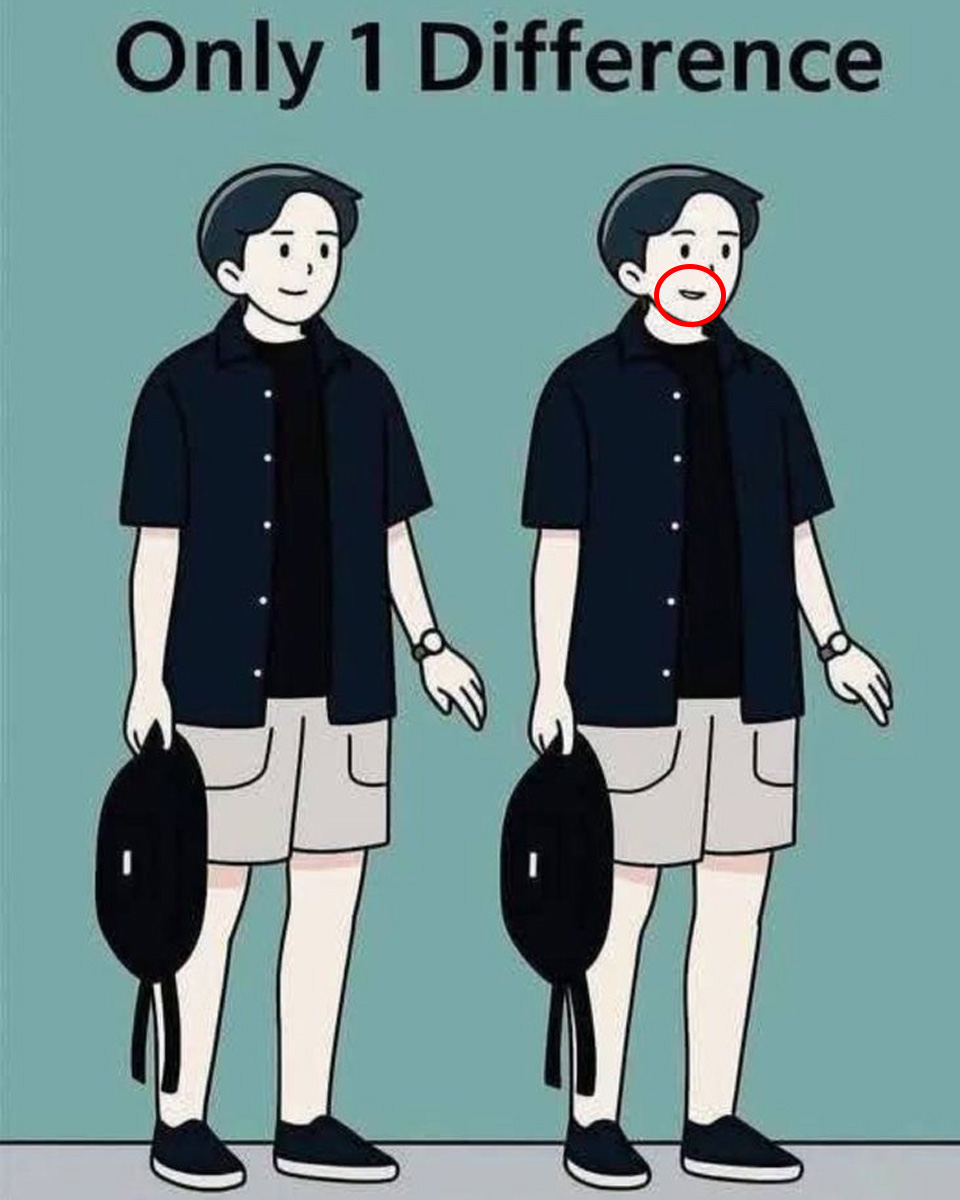
Only 1 Difference: Can You Spot the Mystery Item? - Wake Up Your Mind

by


Imagine stepping into a simple, clean room with cool, light blue walls.

Inside, a cool-looking young man stands next to his perfect twin in picture below.

They are dressed identically and share the exact same easygoing pose.

At first glance, they appear as a perfectly mirrored pair.

However, the title “Only 1 Difference” challenges you to find one hidden variation.

Your mission is to discover that single detail not shared between them.

This fun observation test acts like a quick workout for your eyes.

To solve it, try breaking the image down section by section.

First, check their dark hair, style, and facial expressions from the top.

Are their smiles and features perfectly matched like two identical coins?

Next, examine their outfits: the unbuttoned black overshirts and the white buttons.

Count the buttons carefully to ensure they match on both sides.

Look closely at the black t-shirts and the light grey shorts.

Scan further down to the black socks and matching shoes with white soles.

Now, go into super-detective mode and check the smaller items.

Both guys wear an elegant silver watch with a round white face.

Study the hands and orientation of these watches for any subtle change.

They also each hold a round black bag with two hanging straps.

Inspect these bags and their markings to see if they are identical.

Imagine overlaying one twin perfectly on top of the other.

Would a finger curve differently, or is a tiny detail missing?

This puzzle tests your concentration and ability to slow down and focus.

While many will rush past, your unique focus will lead to victory.

Training your eyes like this helps you notice details in daily life.

Every detail you confirm as identical brings you closer to the answer.

Take a deep breath and give the image one more focused scan.

Look at the clothes, the accessories, and the spaces between them.

The secret is hidden in plain sight, waiting for a skilled observer.

Once you spot it, the answer will seem completely obvious.

The mystery is waiting—you just have to truly see it.

ASNWER:

I Raised My 7 Grandchildren Alone After Their Parents Di3d – 10 Years Later, My Youngest Granddaughter Handed Me a Box That Exposed the Truth

by


People often say that love can heal almost anything. I never truly understood what that meant until the night my world fell apart.


Ten years ago, I buried my daughter and son-in-law after a tragic accident that left seven frightened children without parents. Overnight, I went from enjoying retirement to becoming the sole guardian of seven grieving grandchildren.


There were moments when I wondered if I was strong enough. There were nights when I cried after everyone else had gone to sleep. Every dollar mattered. Every decision felt impossible.


But through every hardship, I made one promise.


"I will never let you feel alone."


For ten years, I believed I knew everything about that terrible night.


Then, on my seventy-second birthday, my youngest granddaughter quietly placed an old wooden box into my hands.


"Grandma," she whispered, "Mom wanted you to have this...but someone made sure you never did."


What I found inside changed everything.


The Night Everything Changed


My daughter Emily was only thirty-six.


She had the brightest smile in every room.


Her husband Daniel adored her, and together they had built a lively home filled with laughter, birthday parties, scraped knees, and endless bedtime stories.


Their seven children ranged in age from four to sixteen.


They were a noisy, beautiful family.


One rainy evening, Emily and Daniel drove into the city for what was supposed to be a short anniversary dinner.


They never came home.


A truck crossed into their lane.


Police called it an unavoidable accident.


Within twenty-four hours, my grandchildren became orphans.


Becoming a Mother Again at Sixty-Two


People praised me for taking all seven children.


They called me brave.


Strong.


Selfless.


They never saw the fear hiding behind my smile.


I had retired only months earlier.


My savings weren't enough.


My house had only four bedrooms.


Every morning became organized chaos.


Packing lunches.


Laundry.


Homework.


Doctor appointments.


School meetings.


Nightmares.


Tears.


The youngest still cried herself to sleep for months.


The oldest blamed himself because he had begged his parents to go out that evening.


Every child grieved differently.


My job wasn't just feeding them.


It was helping them believe life could still be beautiful.


Every Sacrifice Was Worth It


Money disappeared faster than I could earn it.


I sold my jewelry.


I rented out part of the house.


I took part-time bookkeeping work from home.


Some weeks I skipped buying new clothes for myself so the children could join school activities.


Christmas presents came from thrift stores.


Birthday cakes were homemade.


Vacations became backyard camping trips.


Yet somehow...


Those became their favorite memories.


We laughed around campfires made from old bricks.


We watched movies projected onto a white sheet hanging in the yard.


We celebrated every graduation, every lost tooth, every small victory.


Our house wasn't rich.


It was filled with love.


Questions That Never Went Away


Despite moving forward, one question haunted me.


Why had Emily called me three times the day she died?


I had missed every call because my phone battery had died while shopping.


When I listened to the voicemail later...


There wasn't much.


Only static.


Her frightened breathing.


Then silence.


Police couldn't recover anything useful.


I tried convincing myself it didn't matter.


Until strange things started happening.


The Missing Papers


Years later, while organizing family records, I noticed something odd.


Emily's life insurance paperwork was incomplete.


Several financial documents were missing.


Daniel's business records had vanished.


Even stranger...


Nobody seemed concerned.


Their attorney claimed everything had already been settled.


But something felt wrong.


I ignored the feeling.


Life was too busy.


Seven children needed me.


Ten Years Later


Life slowly became peaceful again.


The grandchildren grew into remarkable young adults.


Jacob earned a college scholarship.


Sarah wanted to become a nurse.


Lucas loved engineering.


Emma dreamed of teaching.


The twins opened a small landscaping business.


Little Sophie—the youngest—remained the quiet observer.


She noticed everything.


She asked questions no one else asked.


Sometimes she reminded me so much of Emily it hurt.


My Seventy-Second Birthday


The family gathered for dinner.


Nothing extravagant.


Just homemade lasagna, laughter, and chocolate cake.


After everyone finished eating, Sophie disappeared upstairs.


She returned carrying an old cedar box wrapped in faded blue fabric.


"I found this while cleaning the attic."


She looked nervous.


"I think it belongs to you."


The moment I touched it, something felt familiar.


Then I saw Emily's handwriting.


For Mom.


Open if anything ever happens to me.


My heart stopped.


The Hidden Box


The lock had rusted shut.


Jacob carefully opened it using small tools from his workshop.


Inside were photographs.


USB drives.


Letters.


Bank records.


Insurance papers.


And one sealed envelope.


The handwriting trembled across the front.


Mom...


If you're reading this...


Something has gone terribly wrong.


Emily's Letter


I could barely breathe as I unfolded the pages.


Emily explained that Daniel had discovered financial fraud involving one of his business partners.


Large amounts of money had disappeared from company accounts.


Someone had been using fake contracts and shell companies.


Daniel planned to report everything.


But days before meeting federal investigators, he began receiving threats.


Emily wrote that they feared someone was following them.


She had hidden copies of every important document.


She planned to give them to me.


If anything happened before then...


The box would explain everything.


She ended with one heartbreaking sentence.


Please protect the children.


Reopening the Past


None of us slept that night.


The next morning we contacted authorities.


Investigators examined everything inside the box.


Technology had improved dramatically over ten years.


The digital files recovered deleted emails.


Financial records.


Recorded phone calls.


Hidden account numbers.


The evidence painted a troubling picture.


While officials could not conclude that the fatal crash had been intentionally caused, the newly discovered documents did reveal a significant financial crime that had never been uncovered during the original investigation.


Several people connected to the business were questioned as the case was reopened.


For the first time in a decade, we felt that Emily's efforts to preserve the truth had not been in vain.


Answers at Last


Months later, investigators confirmed Daniel's business partner had orchestrated a long-running embezzlement scheme that stole millions from clients.


The fraud had continued for years before Daniel uncovered it.


Authorities recovered hidden assets and compensated several victims through the legal process.


Although the original traffic collision remained officially classified as an accident due to insufficient evidence linking it to the fraud, Emily's documents ensured the financial crimes were finally exposed.


Justice did not erase our grief, but it restored part of the truth my daughter had tried so hard to protect.


Sophie Reveals One More Secret


One evening I asked Sophie how she had found the box.


She smiled softly.


"I didn't."


I looked confused.


She continued.


"I remembered something."


"When I was four, Mom carried me upstairs before they left that night."


"I saw her hide something behind a loose wooden panel."


"I forgot about it."


"Until last week."


Children remember more than adults realize.


For ten years...


The answer had been waiting in our own attic.


A Family Stronger Than Loss


Looking around the dinner table today fills me with gratitude.


Seven grandchildren.


Seven survivors.


Each carrying a piece of Emily and Daniel forward.


They became compassionate adults because they learned resilience together.


Not because life was easy.


But because they never faced it alone.


Sometimes they thank me for raising them.


I always give the same answer.


"You saved me as much as I saved you."


Because after losing my daughter...


I thought my life was over.


Instead...


Love gave me seven new reasons to keep living.


The Lesson Hidden Inside the Box


People often think the greatest inheritance is money, property, or valuable possessions.


They are mistaken.


The greatest inheritance is truth.


Emily left behind something far more valuable than wealth.


She left courage.


She trusted that someday the truth would reach the people who needed it most.


And because one little girl remembered a hidden box, an entire family finally received the answers they had spent ten years searching for.


Some wounds never fully heal.


Some questions never receive complete answers.

Baby Oil, Aspirin For Younger Looking Spotless Skin …….See more

by


I want to be honest with you upfront. No bottle of baby oil or strip of aspirin is going to undo a decade of sun damage in a weekend. What these two ingredients can do, when you pair them with the right pantry staples, is soften the look of fine lines, dial down dullness, and slowly fade the patchy spots that make skin look older than it is.

Oil & Gas

I’ve been making versions of these for years on a real budget. Some weeks my skin behaved. Some weeks it didn’t. What follows is what actually stuck — six DIYs I keep coming back to, with the reasoning behind each one and the warnings that the cute Pinterest pins always leave out.

Why baby oil works on aging skin

Oil & Gas

Baby oil is mostly mineral oil with a little fragrance. Mineral oil is what’s called an occlusive. It sits on the surface of your skin and slows down trans-epidermal water loss, which is the technical way of saying it keeps moisture from evaporating out of your skin overnight.

Why does that matter for “younger looking” skin? Because dehydrated skin shows every crease. The same fine lines under your eyes that look like crepe paper at 11pm on a dry winter night look softer in the morning after your skin has had eight hours to plump back up. Baby oil traps water in. It doesn’t add water — that’s a different job — but it locks in whatever moisture is already there.

One catch: mineral oil is comedogenic for some people, especially if you’re acne-prone. If you break out easily on the face, use baby oil on your body, neck, and hands instead, or do a small patch test on your jawline for three nights before going all in.

Oil & Gas

Why aspirin works on dark spots and dullness

Aspirin is acetylsalicylic acid. When it dissolves in water, it releases salicylic acid, which is the same beta hydroxy acid sold in fancy serums for forty times the price. Salicylic acid is oil-soluble, so it gets into your pores. It also gently loosens the bonds between dead skin cells on the surface, which is why aspirin masks make skin look brighter the next morning.

For spots specifically, salicylic acid does two things: it sheds the pigmented surface cells faster, and it calms the underlying inflammation that often keeps a spot dark long after the pimple is gone. This is why aspirin works better on post-acne marks than on deep melasma, which sits much further down.

Now the warnings, because these are non-negotiable. Do not use any aspirin DIY if:

You’re allergic to aspirin or any NSAID

Drugs & Medications

You have a known salicylate sensitivity

You’re pregnant or breastfeeding (talk to your doctor first; topical salicylic acid in low doses is usually considered fine but I’d rather you ask)

You’re already using a strong retinol, AHA, or BHA product — pick one or the other, not both

Your skin is broken, sunburned, or actively irritated

Also: salicylic acid makes your skin more sensitive to the sun. Every single one of the aspirin DIYs below should be followed by sunscreen the next morning. I mean it. Without SPF, you’ll fade one set of spots and grow another.

The 6 DIYs

1. Aspirin and honey brightening mask

This is the one I run to before a wedding or any event where I want my skin to look one shade brighter without a filter. The honey adds humectant moisture and a mild antibacterial layer, and the aspirin does the exfoliating.

You’ll need:

3 uncoated aspirin tablets (the cheap, plain white ones — not coated, not enteric, not flavored)

Half a teaspoon of clean drinking water

1 teaspoon of raw honey

Half a teaspoon of plain unsweetened yogurt (optional, but it adds lactic acid for an extra polish)

How I make it: Drop the aspirin tablets into the water in a small ceramic bowl and wait two minutes. They’ll fizz and dissolve into a slightly grainy paste. Stir in the honey and yogurt until it’s smooth and spreadable. Apply a thin even layer to clean, dry skin, avoiding the eye area and the corners of the mouth. Leave it on for ten minutes the first time. If your skin tolerates that with no stinging, you can build up to fifteen on future uses.

Rinse with lukewarm water and pat dry. Follow with a basic moisturizer. Sunscreen the next morning, no exceptions.

How often: Once a week is plenty. Twice a week is the absolute ceiling and only if your skin is on the resilient side.

2. Baby oil overnight glow treatment

This is the laziest entry on the list and somehow the one that gets the most compliments. It’s a two-ingredient overnight occlusive that softens fine lines around the eyes and mouth by morning.

You’ll need:

4 to 5 drops of baby oil

1 vitamin E capsule (pierced with a clean pin)

How I use it: After my regular night moisturizer has soaked in for about five minutes, I squeeze the vitamin E into my palm, add the baby oil drops, rub my hands together, and press the mix gently over the dry zones — under-eyes, smile lines, the corners of the mouth, neck. I avoid the T-zone because that’s where I’m oily anyway.

The trick is to layer baby oil over a water-based moisturizer, not instead of one. Baby oil seals in moisture. If there’s no moisture to seal, you’re just adding oil to dry skin and wondering why nothing changed.

By morning the under-eye area looks fuller and the fine lines look softer. The effect is temporary — it’ll wear off through the day — but with consistent use over a few weeks, the skin in those zones starts holding hydration better on its own.

Skip this if: You’re acne-prone on the face. Try it on the neck and chest instead, where mineral oil rarely causes breakouts.

Oil & Gas

3. Aspirin spot-fading paste

For one stubborn dark spot — the kind a pimple leaves behind months ago and refuses to fully fade — a targeted aspirin paste works better than a full mask. You’re concentrating the salicylic acid on a few millimeters of skin instead of spreading it thin.

You’ll need:

1 uncoated aspirin tablet

2 to 3 drops of water

1 drop of honey (to keep it from drying too fast)

How I use it: Crush the tablet into powder with the back of a spoon. Add the water drop by drop until you have a thick paste — you want it the consistency of toothpaste, not a runny gel. Stir in the honey. Dab a small amount onto the dark spot only, using a cotton swab so you don’t spread it to the surrounding skin. Leave for fifteen minutes, then rinse.

I do this every third night for two weeks, then take a week off. Most post-acne marks visibly lighten within a month if you’re consistent and wearing sunscreen during the day. Deeper hormonal pigmentation needs more than a kitchen remedy — see a dermatologist for that.

4. Baby oil and sugar body polish

The skin on your arms, legs, and chest ages too, and most of us ignore it until we notice that the skin on our hands looks ten years older than the face we’ve been pampering. This polish gives the body a quick reset.

You’ll need:

2 tablespoons of granulated white sugar

1 tablespoon of baby oil

Oil & Gas

A few drops of lemon juice (optional, and only if you’re using this at night)

How I use it: Mix it all in a small bowl until you have a thick, gritty scrub. In the shower, after rinsing off but before drying, I work it in slow circles over knees, elbows, the backs of my hands, my collarbones, and the front of my shins. About sixty seconds per zone. Rinse with warm water.

The sugar buffs off dead skin. The baby oil leaves a moisture barrier behind so you step out of the shower already soft, no separate lotion needed. If you added lemon juice, do this at night only — lemon makes skin sun-sensitive even more than aspirin does.

How often: Twice a week. Daily is too much; you’ll strip your skin barrier and end up flaky.

5. Aspirin and rose water toner

If you want a gentler, daily-ish version of the aspirin mask, dissolve it into rose water and use it as a wipe-off toner. The dilution is low enough that you can use it three times a week without overdoing it.

You’ll need:

4 uncoated aspirin tablets

100 ml of pure rose water (the kind you’d drink, not the perfumed cosmetic version)

A clean glass bottle with a lid

How I make it: Crush the aspirin tablets and drop them into the rose water in the bottle. Shake well. Let it sit for two hours, shaking occasionally, until the tablets fully dissolve. Strain through a clean coffee filter if you want it crystal clear.

Bonnie Tyler, the Voice That Defined a Generation, Dies at 75

by


A Humble in Wales

Born Gaynor Hopkins on June 8, 1951, in Skewen, Wales, Bonnie Tyler grew up in a working-class family where music was always present. From an early age, she dreamed of becoming a professional singer, inspired by the powerful voices dominating radio stations during the 1960s.

Before achieving fame, Tyler performed in local clubs and competitions, gradually developing the confidence and stage presence that would later make her an international star.

Her determination eventually paid off when she signed her first recording contract during the 1970s, marking the beginning of a remarkable musical journey.

The Voice That Changed Everything

One of the most fascinating parts of Bonnie Tyler's story is how her famous voice came to be.

Early in her career, she underwent surgery to remove vocal cord nodules. Doctors instructed her to remain completely silent during recovery. However, Tyler spoke before her voice had fully healed.

The result permanently changed her voice, giving it the distinctive husky sound that would become one of the most recognizable voices in popular music.

What could have ended another singer's career instead became Bonnie Tyler's greatest strength.

Early Success

Tyler's first major breakthrough came with Lost in France before achieving worldwide success with It's a Heartache.

Released in 1977, It's a Heartache became a massive international hit, reaching millions of listeners across Europe, North America, Australia, and beyond.

The song showcased not only her remarkable vocal power but also her ability to connect emotionally with audiences.

Music critics quickly realized they were witnessing the arrival of a unique talent.

The Song That Changed Pop Music Forever

Although Bonnie Tyler already enjoyed success, everything changed in 1983.

That year she released Total Eclipse of the Heart, produced by legendary songwriter Jim Steinman.

The dramatic power ballad became one of the biggest songs of the decade.

It reached No. 1 in numerous countries and sold millions of copies worldwide.

Even decades later, the song continues to receive enormous streaming numbers and remains one of the most recognizable pop songs ever recorded.

A Voice That Could Fill Stadiums

Few singers possessed Bonnie Tyler's combination of power and emotion.

Whether performing energetic rock songs or emotional ballads, she consistently delivered performances that captivated audiences.

Concertgoers often described her live shows as emotional experiences rather than simple performances.

Her unmistakable voice required no introduction.

Within seconds, listeners knew exactly who was singing.

Holding Out for a Hero

Following the success of Total Eclipse of the Heart, Tyler released another iconic anthem.

Holding Out for a Hero became another worldwide favorite after appearing in the film Footloose.

The song remains a staple in movies, television shows, sporting events, and commercials.

Generations who never experienced the 1980s firsthand still recognize the opening notes immediately.

A Career That Lasted More Than Five Decades

Unlike many artists whose careers fade after a few successful years, Bonnie Tyler continued recording music and touring for decades.

She released numerous albums while maintaining a loyal international fan base.

Although mainstream chart success became less frequent, audiences throughout Europe continued filling concert venues wherever she performed.

Her passion for performing never disappeared.

Eurovision Appearance

In 2013, Bonnie Tyler proudly represented the United Kingdom at the Eurovision Song Contest with the song Believe in Me.

Although she did not win the competition, fans appreciated seeing such an iconic performer sharing her talent with a new generation of viewers.

The appearance reminded audiences that Tyler remained one of Britain's most respected musical figures.

Health Challenges

In recent months, concerns grew after reports emerged that Bonnie Tyler had undergone emergency intestinal surgery while living in Portugal.

She spent time in intensive care following complications, and although there were signs of recovery, her condition remained serious.

Her family has now confirmed that she passed away following the illness for which she had been receiving treatment.

Tributes Pour In

Following news of her death, musicians, fans, broadcasters, and public figures began sharing tributes across social media.

Many described Tyler as:

  • A legendary voice.
  • An unforgettable performer.
  • One of rock's greatest female singers.
  • A musical icon whose songs will live forever.

Radio stations around the world quickly began playing her greatest hits in tribute.

An Influence on Future Artists

Bonnie Tyler inspired countless singers with her fearless vocal style.

Many artists admired her willingness to embrace emotion rather than perfection.

Her music demonstrated that authenticity often resonates more deeply than flawless technique.

Even today, young performers continue covering her songs in talent competitions and concerts.

Awards and Recognition

Throughout her career, Tyler earned multiple Grammy nominations and numerous international honors.

She also received recognition for her contribution to British music, including appointment as a Member of the Order of the British Empire (MBE) for her services to music.

These achievements reflected not only commercial success but also the respect she earned within the music industry.

Why Her Music Endures

Many songs become popular for a few months before disappearing.

Bonnie Tyler's biggest hits proved different.

Total Eclipse of the Heart remains a global favorite decades after its release.

The song experiences renewed popularity during major cultural moments, television performances, and even solar eclipses.

Its emotional intensity continues connecting with listeners of every generation.

Fans Across Generations

One remarkable aspect of Bonnie Tyler's legacy is her ability to reach audiences of every age.

Parents introduced her music to their children.

Streaming platforms introduced her songs to younger listeners.

Films, television series, and viral internet videos helped preserve her music for entirely new audiences.

Very few artists enjoy this kind of lasting popularity.

More Than Just One Hit

Although many people immediately think of Total Eclipse of the Heart, Tyler's catalogue includes numerous beloved songs.

Among her most celebrated recordings are:

  • It's a Heartache
  • Holding Out for a Hero
  • Lost in France
  • Making Love (Out of Nothing at All)
  • Have You Ever Seen the Rain
  • Believe in Me

Each showcased different aspects of her extraordinary voice.

The Woman Behind the Fame

Friends and colleagues frequently described Bonnie Tyler as warm, humorous, and deeply appreciative of her fans.

Despite decades of international fame, she maintained close relationships with family and longtime friends.

She often expressed gratitude for the opportunities music had given her throughout life.

Her Lasting Legacy

Bonnie Tyler leaves behind far more than chart records.

She leaves songs that comforted people during heartbreak.

Songs that inspired hope.

Songs that became wedding dances, karaoke favorites, movie soundtracks, and unforgettable concert memories.

Her voice became part of popular culture itself.

Saying Goodbye

The passing of Bonnie Tyler marks the end of an extraordinary chapter in music history.

While her physical presence is gone, her recordings ensure that future generations will continue discovering her remarkable talent.

There Is an Artificial Lake in Our Village: A Hidden Gem That Transformed Our Community

by


The Village Before the Lake

Years ago, our village looked very different. Agriculture was the primary source of income, and farmers depended almost entirely on seasonal rainfall. During dry months, crops struggled to survive, and families worried about water shortages.

The landscape itself was beautiful but lacked a central feature that could unite the community. There were fields, small forests, and winding dirt roads, but no place where everyone could gather to relax or celebrate.

Life followed a predictable rhythm. People worked hard, children played in open fields, and visitors rarely stopped for long. While our village was peaceful, it lacked opportunities for growth.

Everyone understood that something needed to change.


Why the Artificial Lake Was Built

The idea of constructing an artificial lake first emerged during discussions about improving water security.

Engineers and local officials proposed creating a reservoir that could collect rainwater during wet seasons and store it for agricultural use throughout the year.

The objectives were simple:

  • Improve irrigation
  • Reduce flooding
  • Provide reliable water during droughts
  • Support local farming
  • Protect nearby ecosystems

Construction took several years.

Villagers watched with curiosity as heavy machinery reshaped the landscape. At first, many wondered whether such a large project would truly benefit the community.

Few imagined just how significant its impact would become.


The Lake Begins to Fill

After months of work, the rains finally arrived.

Slowly, water accumulated behind the newly constructed dam.

Day after day, the reservoir expanded until it reflected the surrounding hills like a giant mirror.

For many residents, seeing the completed lake for the first time was unforgettable.

Children gathered along the shoreline.

Farmers smiled knowing their crops would have a dependable water supply.

Photographers began capturing stunning sunrise and sunset reflections.

The village had gained an entirely new identity.


A New Home for Wildlife

Nature quickly embraced the lake.

Within a few seasons, birds that had never before been seen in the area began visiting regularly.

Migratory species stopped during their long journeys.

Fish populations grew steadily after carefully managed stocking programs.

Frogs, turtles, dragonflies, and countless insects found suitable habitats along the shoreline.

Native plants flourished, creating natural shelters for small animals.

The lake became a living classroom where children could learn about ecosystems without leaving their village.

Environmental experts noted that artificial lakes, when properly managed, can create valuable habitats for many species while supporting biodiversity.


A Paradise for Birdwatchers

One unexpected benefit was the arrival of bird enthusiasts.

Word spread that dozens of bird species could be observed around the lake throughout the year.

Early mornings became especially magical.

The sound of birdsong echoed across the calm water as mist slowly lifted from the surface.

Photographers carrying long lenses could often be seen patiently waiting for the perfect shot.

The lake became an important stop for nature lovers who appreciated peaceful outdoor experiences.


Supporting Local Agriculture

Perhaps the greatest practical benefit has been improved farming.

Reliable irrigation allows farmers to:

  • Grow crops more consistently
  • Reduce losses during dry seasons
  • Expand cultivated land
  • Experiment with new crops
  • Increase harvest quality

Families who once worried about unpredictable rainfall now enjoy greater stability.

Some farmers have diversified into vegetables, fruit orchards, and specialty crops that previously required more dependable water supplies.

This has strengthened the local economy and improved food security.


Boosting the Local Economy

As the lake gained popularity, new business opportunities appeared.

Local entrepreneurs opened:

  • Small cafés
  • Picnic supply shops
  • Boat rentals
  • Food stalls
  • Guesthouses
  • Handmade craft stores

Weekend tourism created additional income for many families.

Young people who might have left the village for work found employment closer to home.

The lake demonstrated how environmental improvements can also support economic development.


A Favorite Destination for Families

Today, weekends at the lake are full of activity.

Families arrive carrying picnic baskets.

Children ride bicycles along walking paths.

Friends gather for conversations beneath shaded trees.

Some visitors simply enjoy reading a book while listening to gentle waves along the shore.

Unlike crowded tourist attractions, the atmosphere remains peaceful and welcoming.

People come not because they must—but because they genuinely enjoy spending time there.


Recreational Activities Around the Lake

The lake offers numerous outdoor activities suitable for all ages.

Popular choices include:

Walking

Well-maintained trails circle much of the shoreline.

Morning walkers enjoy fresh air and beautiful scenery.

Cycling

Cyclists appreciate relatively flat paths with scenic viewpoints.

Fishing

Where permitted, recreational fishing has become a favorite pastime.

Responsible management helps maintain healthy fish populations.

Photography

Every season creates different landscapes.

Spring flowers...

Summer greenery...

Autumn colors...

Winter mist...

Each offers unique opportunities for photographers.


The Beauty of Every Season

One reason the lake remains fascinating is its constantly changing appearance.

Spring

Wildflowers bloom around the shoreline.

Bird activity increases dramatically.

Fresh green vegetation covers nearby hills.

Summer

Clear blue skies reflect perfectly across calm waters.

Families spend long evenings outdoors.

The sunsets become particularly spectacular.

Autumn

Golden leaves create colorful reflections.

The cooler weather attracts hikers and photographers.

Winter

Morning fog often drifts across the lake, creating a peaceful atmosphere that feels almost magical.

Every season tells a different story.


Environmental Benefits

Artificial lakes can provide several ecological advantages when carefully managed.

These include:

  • Groundwater recharge
  • Flood control
  • Improved water storage
  • Habitat creation
  • Soil moisture support
  • Climate moderation in surrounding areas

Local conservation efforts ensure that these benefits continue for future generations.

Community clean-up events help maintain water quality and protect wildlife habitats.


Educational Opportunities

Schools frequently organize visits to the lake.

Students learn about:

  • Water conservation
  • Aquatic ecosystems
  • Local wildlife
  • Sustainable agriculture
  • Environmental protection

Seeing these concepts firsthand makes learning more engaging than reading about them in textbooks alone.


Community Celebrations

The lake has also become a gathering place for celebrations.

Seasonal festivals, outdoor concerts, charity walks, and cultural events often take place nearby.

Residents decorate public spaces, local musicians perform, and food vendors showcase traditional dishes.

These events strengthen friendships and encourage visitors to experience village life.

The lake has become a symbol of unity.


Challenges and Responsible Management

Like any valuable natural resource, the lake requires ongoing care.

Local authorities and community volunteers work together to:

  • Monitor water quality
  • Prevent pollution
  • Control invasive species
  • Maintain walking trails
  • Protect wildlife
  • Encourage responsible tourism

Visitors are encouraged to leave no litter and respect protected areas.

These simple actions help preserve the lake's beauty.


The Role of Community Volunteers

Many improvements have been possible because residents volunteer their time.

Community members organize:

  • Tree planting projects
  • Shoreline cleanups
  • Educational workshops
  • Wildlife monitoring
  • Environmental awareness campaigns

Their dedication ensures that future generations will inherit a healthy environment.


Tourism with Sustainability in Mind

Rather than pursuing large-scale commercial development, the village has focused on sustainable tourism.

Small businesses emphasize local products.

Guided nature walks encourage appreciation for wildlife.

Visitors are reminded to respect the environment.

This balanced approach allows economic growth while protecting the character of the village.


Lessons Other Communities Can Learn

Our artificial lake demonstrates several important lessons:

  • Long-term planning matters.
  • Environmental projects can strengthen local economies.
  • Community involvement increases success.
  • Sustainable management protects natural resources.
  • Public spaces improve quality of life.

Many villages facing similar challenges could benefit from projects designed around both environmental conservation and community needs.


Looking Toward the Future

Plans continue to improve the lake while preserving its peaceful atmosphere.

Future ideas include:

  • Expanded walking trails
  • Additional picnic areas
  • Educational nature centers
  • Bird observation platforms
  • Native plant restoration
  • Improved accessibility for visitors

Each improvement is carefully considered to ensure that the lake remains a place where nature and people coexist harmoniously.


Conclusion

The artificial lake in our village is much more than an engineering achievement. It represents hope, cooperation, and the remarkable results that can be achieved when a community works toward a common goal.

From supporting agriculture to attracting wildlife, encouraging tourism, and creating cherished memories for families, the lake has become the heart of village life.

Visitors often arrive expecting to see only a reservoir. They leave having discovered something far more meaningful—a place where natural beauty, thoughtful planning, and community spirit come together to create a truly special destination.